Lea Tice, ‘26, never expected to fall in love with circuits.
When she enlisted in the U.S. Army in her hometown of Colorado Springs, Colorado, she had no background in electricity. As an interior electrician, she learned to wire generators, trucks, and military equipment, discovering a fascination with electrical and computer systems.
“That experience working on the generators and the trucks is what made me more interested in doing computer engineering as a career,” Lea says.
By the time she left active duty, she wanted better to understand how systems work. She also wanted to know why they work.
That curiosity eventually led Lea to Indiana State University.
After she earned an associate degree in information technology from San Bernardino Valley College, Lea’s family relocated to Indiana in 2022. Her new home happened to sit directly across the street from Indiana State’s campus in Terre Haute.
“I thought, ‘Well, I might as well get a degree! I’m right here,’” Lea says with a laugh.
Using GI Bill benefits and support through the Veteran Affairs Vocational Rehabilitation program, Lea enrolled at Indiana State. She began as a computer science major but quickly realized she wanted something more hands-on. She wanted to be an engineer.
She found the perfect fit in the Computer and Electrical Engineering Technology program, adding minors in computer science, information technology, and security and risk. The connection between her military experience and her coursework became clear during her first direct current [DC] circuits class.
“I’m a hands-on person, so everything just clicked. The math wasn’t as hard as people try to make it out to be,” Lea says. “I really enjoyed the problem-solving part, too.”
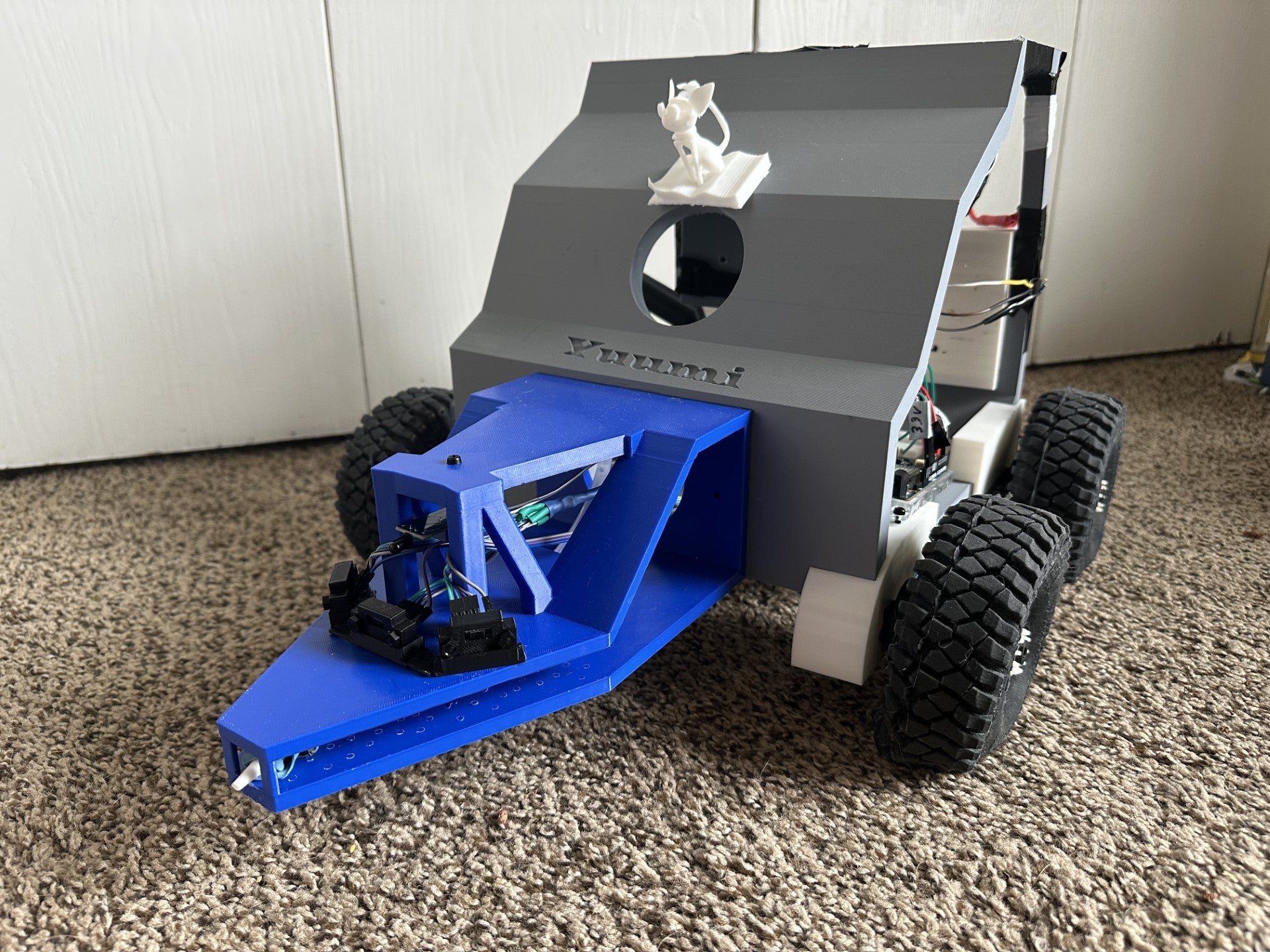
The program’s hands-on labs reinforced what Lea learned in the classroom. Each project helped transform complex concepts into practical skills, culminating in a senior capstone project where Lea designed and built an autonomous firefighting robot.
For the project, Lea was responsible for modeling 3D-printing components, writing codes, and integrating sensors capable of detecting flames. Once detected, the sensors would spray water. The project introduced the Sycamore to systems engineering.
Throughout her studies, Indiana State’s faculty have helped Lea recognize and build on her potential. Lea credits Maria Javaid, PhD, Xiaolong Li, PhD, and Alister McLeod, PhD, for challenging and encouraging her throughout the academic program.
“They didn’t make anybody feel stupid,” she says. “They have a really good way of harnessing everybody’s potential.”
That support mattered most when Lea experienced moments of self-doubt. She explains, “I felt I wasn’t qualified for certain jobs, but Dr. Javaid showed me that I was. She helped me believe in myself.”
Dr. Javaid recalls Lea as being a highly driven student from the moment she enrolled in her Introduction to Robotics and Automation course.
“I found her a very committed, ambitious, and respectful student,” says Dr. Javaid, who served as Lea’s supervisor as she completed her senior capstone project. “Lea was a student who was not only good at technical skills but also a very cooperative team member. I was proud to see her secure multiple job offers from leading tech companies before she graduated.”
Following graduation, Lea entered a cohort program at Philips, a medical device manufacturer that controls roughly 65 percent of the market in several product lines, including image-guided therapy systems. Lea is currently training to work on those systems as a field service engineer. The cohort is designed to help new engineers transition into the profession.
Her role has already taken Lea across the country, from Nashville for X-ray training and to Cleveland for image-guided therapy systems training.
“It’s a stepping stone to my future as an engineer. I’m learning so much at Philips,” Lea says.
Her long-term goal is to become a systems engineer, a path inspired by the firefighting robot that first exposed her to the field. She has also been accepted into an online master’s program in electrical and computer engineering at the University of Colorado Boulder.
“Lea’s success story should be seen as an example of what students can achieve if they pursue their degree at Indiana State with dedication and utilize the learning and professional growth opportunities available to students,” Dr. Javaid says.
Outside the classroom, Lea found community on campus through Indiana State’s Women in STEM Professions organization, the Institute of Electrical and Electronics Engineers (IEEE) chapter, and the Cyber Sycamore Club.
At 33, Lea was older than many of her classmates, but those organizations helped her connect with students who shared her interests and career goals in engineering. That sense of belonging is what she remembers most about her time as a Sycamore.
“You can feel it at Indiana State,” Lea says. “I didn’t question if I belonged there or if it was too late for me to go back to school. Everyone really cares. The students are great. We were all in it together. It’s nice to see people lift each other up.”
From Army service to working on a robotic firefighter, and now to building an engineering career, Lea’s path has been unique. Looking back, she sees each step as part of a larger journey.
Indiana State, she says, was the place that connected all the dots.