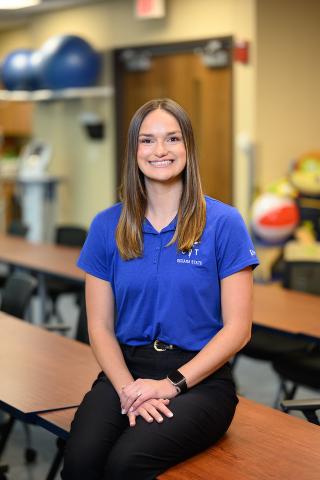
For Karsyn Mette, occupational therapy (OT) is where creativity meets purpose.
No two clients are exactly alike. Neither are the things that matter most to them. One person might want to return to work while another wants to get dressed independently. Someone else might simply want to enjoy their favorite hobbies again.
That’s the heart of occupational therapy, a field focused on helping people develop, regain, or adapt the skills they need to participate in everyday activities that are important to them. Because those goals look different for every person, occupational therapists learn to tailor treatment around the individual.
“What stood out for me about occupational therapy was the creative side of it. We can alter our treatment to meet needs. If that’s being able to get up and bake cookies for your grandkids in the morning, we can focus our treatment around that and really hit home on those things.”
That individualized approach is one of the things that drew Karsyn to the OT field. It also means occupational therapists can work with people across ages, abilities, and settings.
“Occupational therapy is very wide. You get to work with adults and children. There’s just so much that you can do,” she adds.
At Indiana State University, Karsyn has spent the past several years building skills to turn that individualized approach into a career.
She will graduate this December with a master’s degree in occupational therapy, completing a journey that began after she earned an associate’s degree near her hometown of Effingham, Illinois. She transferred to Indiana State for her junior year and earned her bachelor’s degree in psychology in 2023, hoping eventually to earn a place in the University’s occupational therapy graduate program.
When she was admitted, staying at Indiana State felt like the right choice.
“I really liked the small community on campus. Everything is in one area,” Karsyn says. “That’s what really drew me here.”
She found that same sense of community within the Occupational Therapy program. A smaller cohort has allowed her to form close relationships with classmates and learn from professors with experience across the field. Those faculty members have challenged her, but they also make themselves available when she needs extra help, has a question, or simply wants to talk to someone.
“They set aside that special time for us,” she says. “It’s nice to have someone to talk to.”
Karsyn’s education has extended far beyond the classroom. At the Rural Health Innovation Collaborative (RHIC) Simulation Center, she has worked with simulated patients, giving her opportunities to practice her skills before treating clients in clinical settings.
“There are a lot of hands-on experiences offered in the graduate program,” Karsyn says.
Some experiences, however, can’t be recreated in a simulation, specifically working with children.
To build her pediatric skills, Karsyn worked directly with children in community settings. From there, she moved into additional fieldwork and clinical experiences, including time at the Vigo County Juvenile Justice Center and Sarah Bush Lincoln Center in Mattoon, Illinois.
At Sarah Bush Lincoln, she progressed from observing her supervising OT to working with clients under supervision. By the end of the experience, she was managing a full caseload.
“You have a short time within the graduate program to learn all the things. That’s why it’s important to have the fieldwork. You’re able to really focus and practice the skills that you’re learning in the classroom. It’s a good way to put those into practice.”
Karsyn had already begun building those skills as an undergraduate. During an internship at Ascension St. Vincent, she assisted an OT three days a week. She also served as a personal support worker for a teenager with special needs, assisting with daily routines, including bathing and dressing.
“It was a great experience to just see occupational therapy and understand some of the terminology before I even started the graduate program,” she says.
During one of her pediatric experiences, Karsyn saw just how much those skills could matter.
A young girl with a genetic condition needed help becoming independent with toileting care. Her mother hoped she could learn to manage the routine on her own at school.
At first, the girl didn’t believe she could.
“She was like, ‘Oh, I can’t do it. I can’t do it,’” Karsyn recalls.
Karsyn worked with her one-on-one. And, little by little, something changed.
“Within two months, she was independent,” Karsyn says. “All of a sudden, she was doing it all by herself. That was a huge accomplishment.”
For the Sycamore, that moment captured what makes OT so meaningful. Helping someone isn’t about deciding what success should look like for them. It begins with listening to what they want their life to look like.
“You really get to understand the patients and what they want to do. That’s my favorite thing about it,” Karsyn says. “Whatever is meaningful to the client is what I think is most special.”
That focus on the individual has shaped Karsyn’s overall experience at Indiana State, including her research in the graduate program.
Working with a faculty advisor and her classmates, Karsyn studied poverty simulations in a project that brought together Occupational Therapy and Physician Assistant students. Participants reflected on the experience afterward, with many reporting greater empathy for people experiencing poverty and a desire to carry that perspective into their future work.
Karsyn and her classmates later presented a poster about the project at the American Occupational Therapy Association conference in California. “That was really cool,” she says with a smile.
After graduating in December and passing her boards, Karsyn plans to return to Effingham to begin her career in a pediatric clinic at HSHS St. Anthony’s Memorial Hospital. There, she’ll continue learning alongside other OTs while working with children receiving occupational, physical, and speech therapy.
For students considering occupational therapy, Karsyn recommends a simple first step: see the work for yourself.
“Reach out to any OT. I know all of them would be more than happy to have you follow them around and understand what it’s all about.”
Watching became practicing for her. Then, practicing grew into confidence. Through the classroom, research, fieldwork, and clinical experiences at Indiana State, Karsyn has learned that making a difference doesn’t always require a dramatic breakthrough.
Sometimes, it’s helping someone do something they once believed they couldn’t.